A furnace that will not heat, blows cold air, or keeps shutting itself off is telling you something specific. We diagnose the actual failure — ignition, flame sensing, airflow, blower or control board — before recommending any repair.
A furnace blowing cold air is usually a delayed or failed ignition, a dirty flame sensor shutting the burner off right after it lights, or a thermostat set to fan-only mode. It can also mean the burners lit briefly and then locked out on a safety switch, which leaves the blower running with no heat behind it. We check ignition, flame sensing and the limit switch in that order, since that sequence covers the vast majority of cold-air calls.
Why Won't My Furnace Start?
A furnace that will not start at all is either not getting power or control signal, not getting gas, or has failed a safety lockout. Common causes include a tripped breaker, a bad thermostat connection, a closed gas valve, a failed igniter, or a flame sensor reading dirty enough that the control board refuses to keep the burner lit. We work through power, control and gas in sequence to find where the chain breaks.
Why Does My Furnace Keep Turning On and Off?
Short cycling is most often caused by restricted airflow — a clogged filter or blocked return — that makes the furnace overheat and shut down on its limit switch before it finishes a normal cycle. A failing flame sensor, an oversized furnace, or a control board misreading a safety signal can also cause it. Left alone, short cycling wears down the blower motor and ignition components faster than normal operation.
Common Furnace Problems We Repair
The parts that fail most often are the igniter, the flame sensor, the blower motor, the control board, the limit switch and the thermostat. Airflow restrictions from a dirty filter or blocked duct cause a large share of calls that look like equipment failure but are not. We also address combustion and venting problems, which affect both performance and safety and are never something to leave unresolved.
What We Check During Furnace Diagnosis
A proper diagnosis walks the full sequence of operation: thermostat call, ignition, flame proof, blower engagement, and heat delivery through the ducts. We test electrical components with a meter rather than guessing by sound or age, check gas pressure and combustion readings, and inspect the venting for blockage or damage. That sequence tells us exactly which component failed instead of leaving it to trial and error.
Furnace Safety Checks
Every repair visit includes a check of the heat exchanger, flue connections and combustion readings, because a cracked heat exchanger or blocked vent can let carbon monoxide into the home. We will not restart a furnace we believe is unsafe to run, and we will tell you plainly if that is the case rather than patching around it.
What Happens During Furnace Repair?
Once we identify the failed component, we explain what it is, why it failed, and quote a flat price before doing any work. Most repairs — igniters, flame sensors, blower motors, capacitors, control boards — are completed the same visit using parts we carry on the truck. If a part needs to be ordered, we will tell you the realistic timeline rather than an optimistic one.
Can My Furnace Be Repaired?
Almost any furnace can be repaired in the sense that a failed part can be replaced. The real question is whether it should be. A furnace under ten to twelve years old with a single component failure is usually a straightforward repair. An older unit with a major failure — a cracked heat exchanger, for instance — is a case where we will walk you through furnace installation as the more sensible option.
When Does Furnace Replacement Make More Sense?
Replacement starts to make more sense once a furnace is in its late teens or older, has a safety-related failure like a cracked heat exchanger, or has needed more than one significant repair in a short span. At that point the repair cost is being spent on a system near the end of its service life. Comparing the repair estimate against a furnace installation quote is the honest way to decide.
What Affects Furnace Repair Cost?
Repair pricing depends on a few concrete factors, which we confirm during diagnosis before quoting.
Which component failed and its part cost
Whether the part is stocked on the truck or needs ordering
Access — a furnace in a tight crawlspace or attic takes longer than one in a utility room
Age and general condition of the system
Whether the failure is isolated or points to a larger underlying problem
Parley's Advice
Check your thermostat batteries, breaker and filter before calling — those three account for a surprising share of no-heat calls and take two minutes to rule out. If the furnace still will not run, call before the house gets cold rather than waiting overnight.
Work Like This Around Utah County
Typical calls our technicians run from the Orem shop.
Orem
No-heat call from a failed igniter
A common call is a furnace that will not light at all, traced to a cracked hot surface igniter and replaced the same visit.
Utah County
Short cycling from a clogged filter
A common job is a furnace shutting off every few minutes because a heavily clogged filter was restricting airflow enough to trip the limit switch.
Orem
Cold air traced to a dirty flame sensor
A common call involves a furnace that lights, blows cold air briefly, then shuts off, fixed by cleaning a flame sensor that had built up a layer of oxidation.
Why Homeowners Call Parley's
One Orem Location
864 N 1430 W in Orem — the same shop for every job we run in Utah County.
Plumbing + HVAC
Water, heat and air under one roof, which matters when a problem crosses lines.
Diagnose, Then Quote
We find the cause before recommending work, so you are not paying for guesses.
Straight Replacement Talk
When a repair still makes sense we say so, and when it does not we explain why.
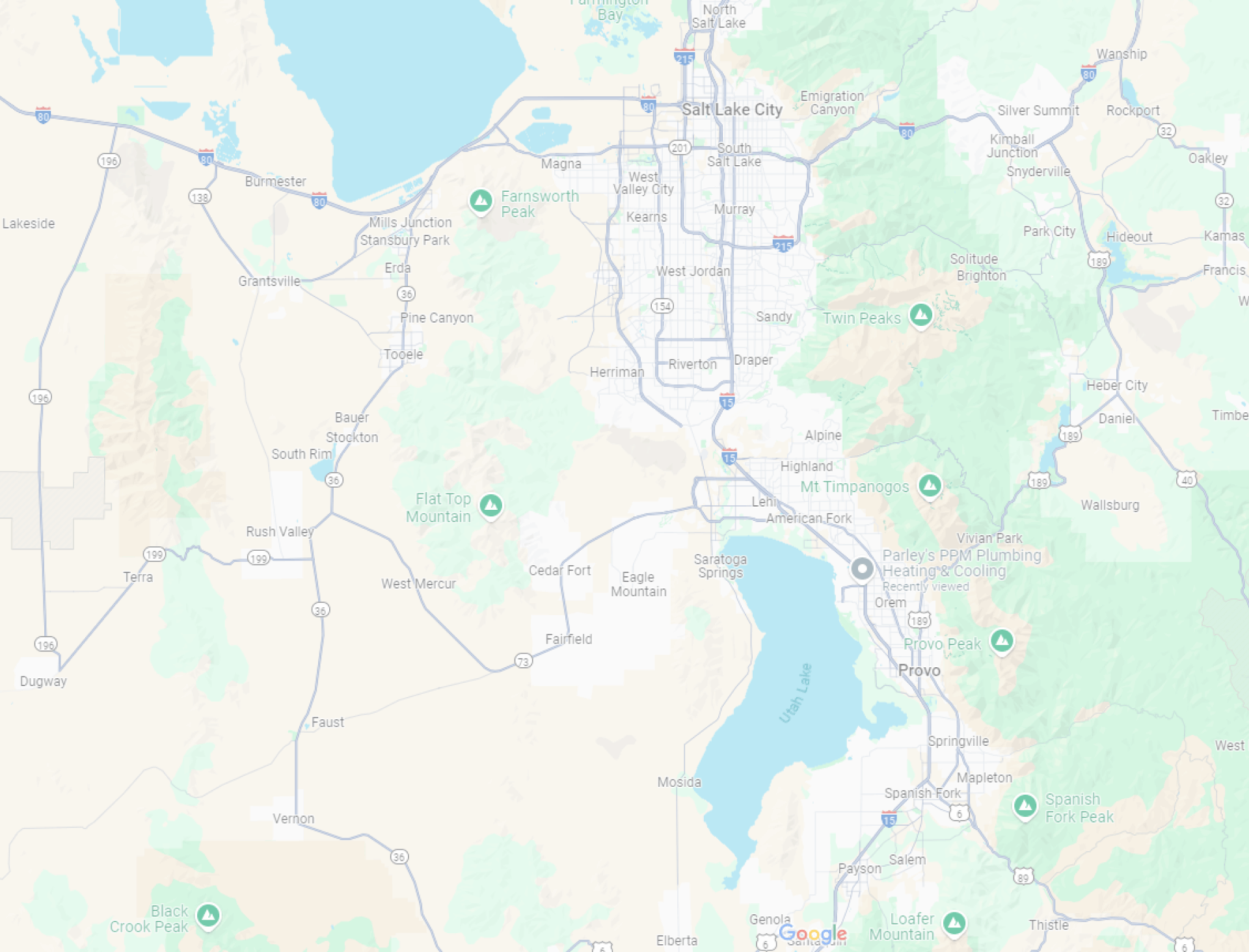
Heating Throughout Utah County
We work from Orem outward, which keeps drive times short across the north end of Utah County and reasonable everywhere else we serve.
Call (801) 226-3033 to schedule furnace repair in Orem or anywhere in Utah County. We diagnose the actual cause and quote a flat price before starting.