A tankless water heater can mean continuous hot water and a smaller footprint, but it is not automatically the right fit for every home. We evaluate your gas line, venting and usage before recommending one.
A tankless unit heats water as it passes through the system, using a high-output burner or electric element, rather than storing and continuously reheating a tank of water. Hot water is available as long as demand stays within the unit's rated flow rate, which is why sizing to actual household usage matters more with tankless than with a tank.
Benefits
Within its flow capacity, a tankless unit can supply hot water continuously rather than running out after a set volume, which helps households where several fixtures run hot water close together. It also takes up significantly less physical space than a storage tank and can offer better standby efficiency, since it is not continuously reheating stored water it is not using.
Limitations & Tradeoffs
Tankless is not without limits. Output is capped by the unit's flow rate, so demanding more hot water at once than the unit can supply — several showers plus a dishwasher, for example — can still reduce flow or temperature. Installation often costs more upfront than a tank due to gas line and venting requirements. And tankless units are not immune to hard water — scale buildup inside the heat exchanger can reduce efficiency and lifespan without regular maintenance.
Proper Tankless Sizing
Tankless sizing is based on flow rate — gallons per minute the unit can heat to a usable temperature — matched against your household's realistic peak simultaneous usage, not the number of people living there. Undersizing leads to temperature or flow drops when multiple fixtures run at once, which is one of the most common complaints with a poorly sized tankless install.
Gas Line & Venting Requirements
Tankless units typically require a higher gas flow than a standard tank heater, which sometimes means upsizing the gas line to the unit. Venting requirements are also different, usually needing dedicated venting rated for the unit's exhaust. We evaluate both before recommending tankless, since skipping this step is how installations end up underperforming.
Tankless Installation
Installation includes confirming gas line capacity, installing correct venting, mounting the unit, and connecting water lines, along with any code-required components. We size the unit to your household's actual demand rather than installing a generic size and hoping it performs.
Tankless Repair & Maintenance
Tankless units can develop the same categories of problems as any water heater — ignition issues, sensor faults, flow problems — and are diagnosed the same way: identify the actual failure before recommending a fix. Maintenance for tankless units centers on periodic descaling, since mineral buildup inside the heat exchanger is the most common cause of reduced performance over time.
Utah Hard Water Matters
Utah County's hard water is a significant factor for tankless owners specifically, because scale builds up inside the narrow heat exchanger passages faster than in a standard tank, and a tankless unit is more sensitive to that buildup. Regular descaling helps manage it, but a water softener addresses the mineral content before it reaches the unit at all, which is the more effective long-term protection.
Tankless vs Tank Water Heater
A tank stores hot water and is generally less expensive to install, while tankless heats on demand and can supply continuous hot water within its flow rate at a higher upfront installation cost. Households with high or overlapping hot water demand, or those prioritizing space and standby efficiency, tend to see the most benefit from tankless. Households with simpler demand patterns may not see enough benefit to justify the added installation cost.
What Does Tankless Installation Cost Depend On?
Tankless installation cost varies based on a few key factors.
Whether the existing gas line needs to be upsized
Venting changes required for the specific unit
Unit flow-rate capacity matched to household demand
Whether this is new installation or a tank-to-tankless conversion
Any additional code-required components
We evaluate your gas line and venting before quoting, so the price reflects the actual installation needed.
Parley's Advice
Before choosing tankless, ask us to calculate your household's realistic peak simultaneous hot water demand. Getting that number right is the difference between a system that performs well and one that disappoints.
Work Like This Around Utah County
Typical calls our technicians run from the Orem shop.
Orem
Tank-to-tankless conversion
A common call: a household replacing an aging tank with a tankless system to reclaim closet space and address frequent hot water shortages. Gas line and venting were upgraded as part of the installation.
Utah County
Descaling an existing unit
A common call: a tankless unit showing reduced hot water output after several years without maintenance. Descaling the heat exchanger restored normal performance.
Orem
Ignition fault repair
A common call: a tankless unit intermittently failing to ignite. Diagnosis found a sensor fault, which was repaired without needing to replace the unit.
Why Homeowners Call Parley's
One Orem Location
864 N 1430 W in Orem — the same shop for every job we run in Utah County.
Plumbing + HVAC
Water, heat and air under one roof, which matters when a problem crosses lines.
Diagnose, Then Quote
We find the cause before recommending work, so you are not paying for guesses.
Straight Replacement Talk
When a repair still makes sense we say so, and when it does not we explain why.
Water Heaters Throughout Utah County
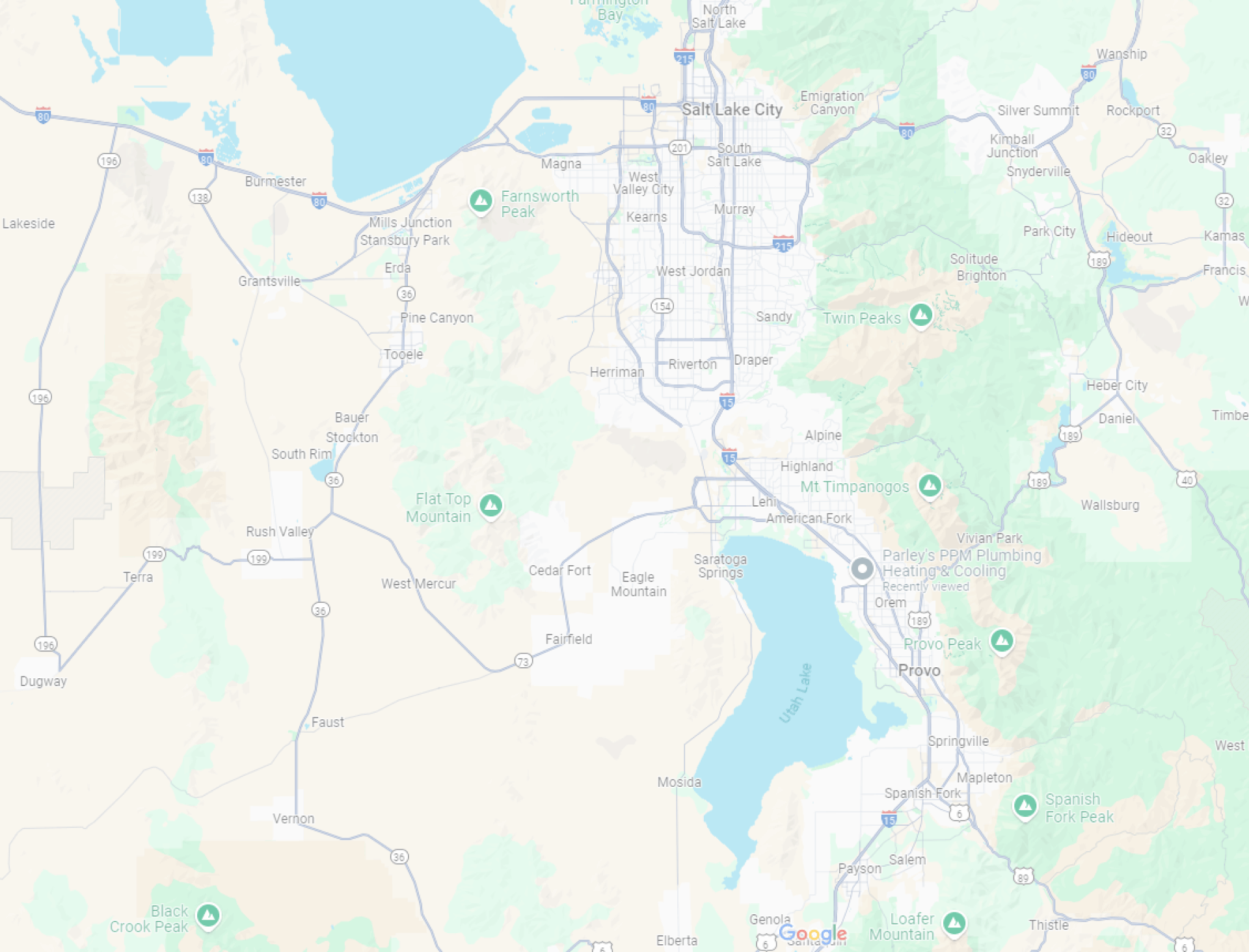
We work from Orem outward, which keeps drive times short across the north end of Utah County and reasonable everywhere else we serve.